The Shift from Standardized Cells to Custom Geometries
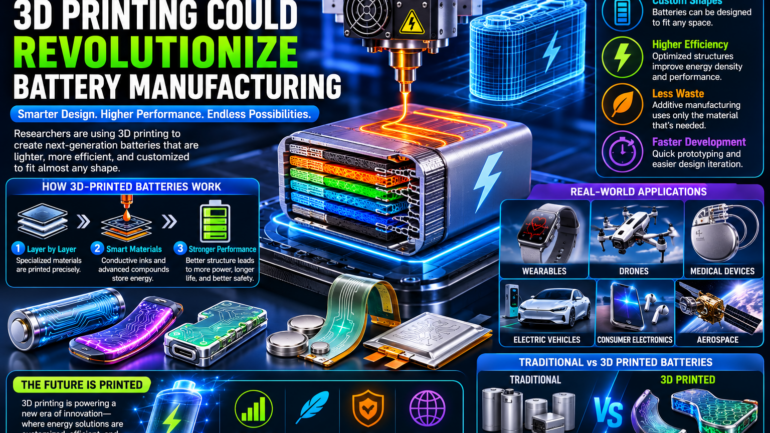
Historically, product design has been constrained by the physical limitations of standardized battery formats, such as AA, AAA, 18650, and pouch cells. Engineers typically reserve space for these rigid components first, forcing the rest of the device architecture to conform to the battery’s shape. This approach limits design flexibility, particularly in compact or ergonomically complex devices where internal space is at a premium.
The Role of 3D-Printable Gel Polymer Electrolytes
Recent research into 3D-printable gel polymer electrolytes offers a solution to this constraint. Unlike traditional liquid electrolytes, which pose leakage risks and manufacturing limitations, gel polymer electrolytes combine ionic conductivity with a stable physical structure. This stability allows for additive manufacturing, enabling the creation of complex, three-dimensional battery architectures that conventional 2D film production methods cannot achieve.
Designing for Robotics and Wearables
This technology is particularly beneficial for robotics and wearable electronics, where components must fit into irregular, curved, or compact spaces. In humanoid robots, for instance, batteries can be designed to conform to curved limbs, torso structures, and circular mechanisms, maximizing the use of available internal cavities. Similarly, wearables like smartwatches and health sensors can utilize ring-shaped or frame-following battery geometries, allowing the power source to integrate seamlessly into the device’s form factor rather than occupying a dedicated rectangular space.
Performance and Safety Considerations
Beyond spatial efficiency, additive manufacturing allows for precise control over internal battery structures, which can influence ion transport, electrode spacing, and thermal behavior. While gel polymer electrolytes offer improved containment compared to liquid alternatives, battery safety remains a multifaceted issue dependent on overall chemistry, electrodes, and manufacturing quality. Significant challenges regarding material performance, cycle life, and manufacturing scale must be addressed before this technology becomes widely adopted.
A New Paradigm in Product Design
This advancement represents a fundamental shift in design philosophy: the product will no longer need to be shaped around the battery. Instead, the battery can be manufactured to fit the product’s specific geometry. As devices increasingly conform to the human body and complex environments, the ability to design power sources that adapt to these forms will be essential for the next generation of electronic innovation.