Overview of Growth Printing
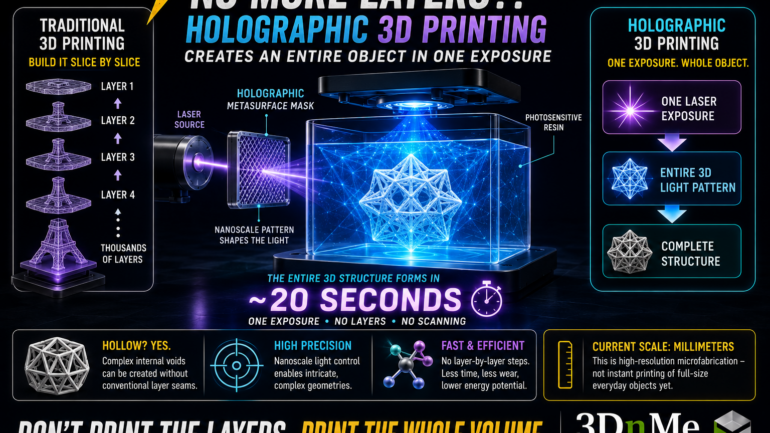
Researchers at the University of Illinois have developed an innovative technique called growth printing, which involves the formation of solid objects from liquid resin through a heat-triggered chemical reaction. This method contrasts with traditional 3D printing, where objects are constructed layer by layer. Instead, growth printing allows for the creation of objects that appear to grow out of a pool of liquid, offering a unique approach to additive manufacturing.
Process and Mechanics
The growth printing process begins with a heated metal starter introduced into a specially formulated liquid resin. This heat initiates a chemical reaction that causes the liquid resin to solidify. As the starter moves upward, the reaction continues to propagate, solidifying material behind it. This technique enables the creation of intricate three-dimensional features without the need for a conventional extrusion nozzle or stacked layers.
Demonstrated Capabilities
Researchers have successfully created objects with complex geometries, such as pinecones, pumpkins, raspberries, and acorns. These examples showcase the potential of growth printing to produce detailed and organic shapes through a controlled chemical process.
Challenges and Future Directions
While the concept of growth printing is promising, it is currently experimental and not ready for commercial use. Key challenges include ensuring shape control, repeatability, and the selection of appropriate materials. Additionally, practical manufacturing applications need further exploration to determine the viability and potential of this technology.
Conclusion
The future of 3D printing may involve the creation of objects through growth rather than traditional layer-by-layer construction. This new method, utilizing a self-propagating reaction front, could revolutionize the way we think about and implement additive manufacturing processes.